The new planning framework represents the most extensive urban-planning intervention ever undertaken in Santorini, aiming to address the unregulated development outside approved plans, the intense tourism pressure, and the need to protect the island’s unique natural and architectural landscape. A central pillar of the proposal is the radical restructuring of land-use zones, whereby protected areas are expected to increase from approximately 22% to more than 65% of the island’s total surface, while zones permitting tourism-related uses are reduced from roughly 60% to just 6–7%.
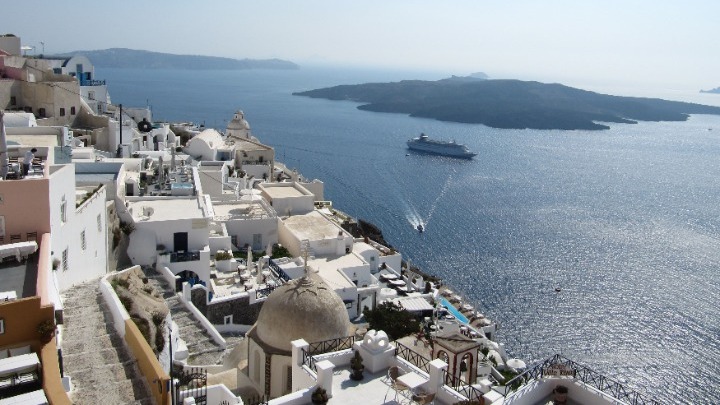
The caldera and its slopes are designated as an Absolute Protection Zone, where all new construction activity is strictly prohibited. This includes the coastline from northern Oia to Akrotiri, as well as Thirasia. The designation was made on grounds of geological stability, aesthetic value, and the international significance of the landscape.
In agricultural areas, zones are defined to protect vineyards and volcanic soils, where only agricultural uses and very limited building activity are permitted. A significant regulatory change concerns the minimum plot size for building: from the current 4 stremmas, an increase to 8 stremmas for residential development is proposed. In practice, this means that a large proportion of out-of-plan parcels will no longer qualify as buildable.
In limited residential development zones, only low-intensity construction is allowed, and large tourist accommodations are excluded. Tourist-development zones, by contrast, are drastically restricted: only specific areas around Kamari and Perissa may host new large-scale facilities, and even then under stringent conditions. For tourist installations, the plan sets a minimum buildable plot of 40 stremmas, a floor-area ratio of 0.15, and a maximum capacity of 150 beds, with the aim of halting the dispersed proliferation of small and medium-sized hotels across the island.
Within existing settlements, the Special Urban Plan maintains traditional building regulations, particularly concerning height, volumetrics, and architectural form. At the same time, measures are introduced to alleviate traffic and enhance walkability, especially in Fira and Oia.