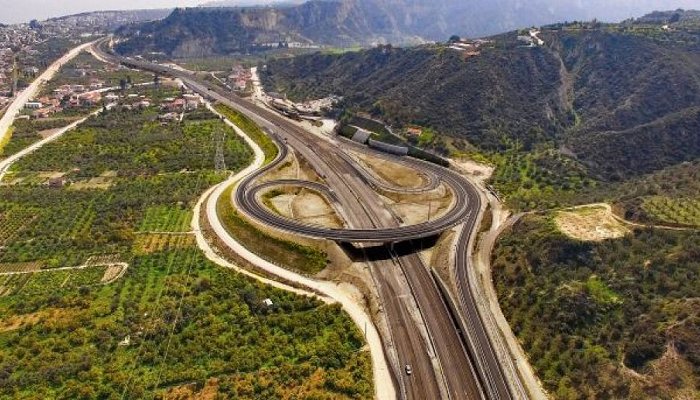
According to the proposed plan, the alignment of the new highway is designed with the aim of minimizing expropriations and reducing environmental impacts. Thus, over a significant portion of the total route, the new alignment either coincides with or runs parallel and close to the existing BOAK, while in other sections it is routed outside the existing corridor. This choice is linked to the need to apply geometric specifications suitable for a design speed of 100 km/h, so that the road meets the characteristics of a modern motorway. Overall, approximately 69% of the new highway incorporates the existing BOAK, while the remaining 31% is developed as a new, independent alignment.
Construction along the existing corridor requires measures to maintain traffic during the works, without causing significant problems, as the elevation profile of the existing road is largely preserved.
The Heraklion–Chania section, 157 kilometers in length, constitutes the core of the project and includes two lanes per direction, with an emergency lane. The project involves the construction of 26 tunnels, 10.8 kilometers of new bridges (23 of which exceed 100 m in length), 20 new interchanges, and the upgrading of 18 existing ones in the bypasses of Chania, Rethymno, and Heraklion. With the option exercised, the new BOAK will have 43 interchanges, 23 tunnels, and 89 bridges, creating an infrastructure project at the top technical level in Greece.
The concession agreement between the Hellenic Republic and the companies Diktaios Concessions S.A. and GEK TERNA S.A., ratified last May by parliament, has a total duration of 35 years, of which 5 years concern the study and construction period.
With the start of preliminary works, road safety interventions are being implemented at dangerous points in the road network, with some starting during the summer.
The overall strategic objective is to create a unified, modern, and safe motorway spanning all of Crete, from Kissamos to Sitia. Studies have already been prepared for the eastern extension of the project from Agios Nikolaos to Pahia Ammos, and financing is planned for the next section from Pahia Ammos to Sitia.
Tripartite Financing Structure
The project is secured through a complex financing scheme:
Private investment by the concessionaire of €219.3 million, rising to €243.5 million if the option is exercised.
Public funding of €693 million, increasing by €99 million with the exercise of the option.
Commercial bank loans of €971.8 million (or €1.079 billion with the option).
Tolls and Shadow Revenue
The project sets a maximum toll of €0.053 per kilometer (2022 prices, excluding VAT), the same as other motorways in the country. Toll revenues are insufficient to fully cover the cost of the infrastructure; therefore, shadow toll payments are foreseen from the State to the concessionaire, at a rate of 64.62% of the corresponding toll. If the investment exceeds the agreed return threshold, the percentage gradually decreases until full elimination.
Progress on the Other Two Sections
Regarding the remaining sections:
In April 2023, the contract was signed for the BOAK section from the Hersonissos interchange (Heraklion) to Neapoli (Lasithi), 22.5 km long, with a budget of €290 million, of which €90 million will be financed by the Recovery Fund.
This is one of three sections of the northern Crete corridor (BOAK) implemented through a PPP by the consortium TERNA, Aktor Concessions–Intrakat, under a 30-year contract.
The third and smaller section, Neapoli–Agios Nikolaos, 14.5 km, has already started and is being constructed by Aktor as a public project with a budget of €169 million.